Ares, God of War
Introduction
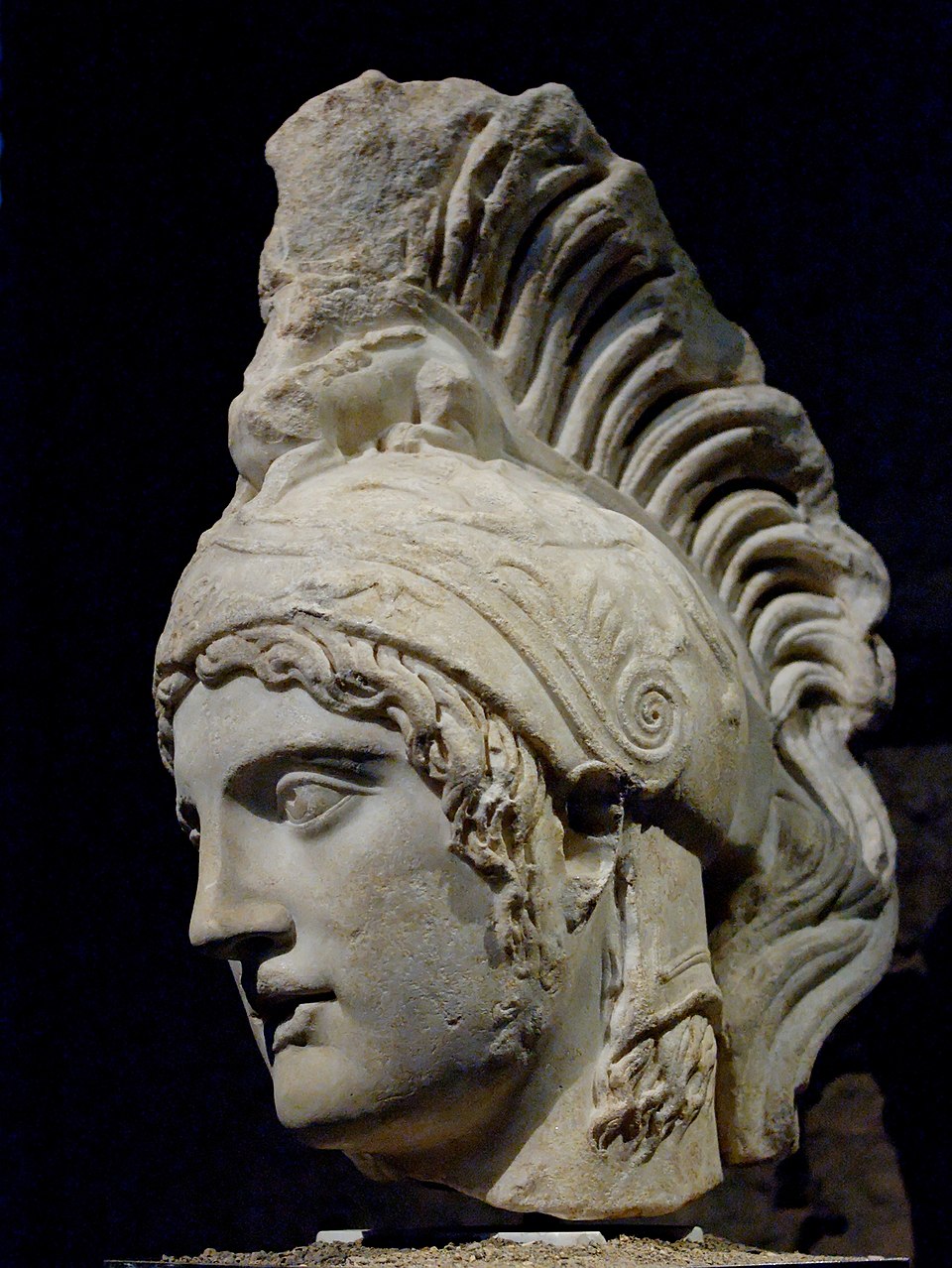
Ares (Ἄρης) is commonly described as the god of war, courage, fighting, bloodlust, and brutality, and is despised for this even by the other gods, including his own father Zeus. (Homer, Iliad V. 890) [trans. Lattimore]:
"Do not sit beside me and whine, you double-faced liar.
To me you are the most hateful of all gods who hold Olympus.
Forever quarrelling is dear to your heart, wars and battles.
And yet I will not long endure to see you in pain, since
you are my child, and it was to me that your mother bore you.
But were you born of some other god and proved so ruinous
long since you would have been dropped beneath the gods of the bright sky."
In a less obvious way, requiring a bit more reflection on his myths, Ares is primarily the god of perseverance and the pursuit of victory. The god who is almost always shown in myths losing a war or being imprisoned, but who always returns to fight. Ares never gives up, on the contrary, he always seeks to win.
Furthermore, Ares can also be considered the god of vengeance or retribution. When his children are murdered or raped, he kills or attempts to kill the criminal (when he fails, it is due to the intervention of other gods).
By extension, he is also a protective father, because when one of his children committed a crime and the gods wanted to punish him severely, Ares would intervene and obtain a more lenient punishment.
His most notable symbols are the shield and the spear, symbolizing attack, but also defense. As the saying goes: "sometimes the best defense is a good offense." And also the peaked helmet, which he is depicted wearing in almost all works.
In short, we can say that Ares is the god of falling and rising again, never giving up on our goals, fighting for them every day. And the harder it is, the more interesting it becomes for the god. The struggle is the part he enjoys most in a goal. And if we think about the "the longing to want and the boredom of possessing," it's understandable that he prefers the movement, the conflicts, and the challenges that arise during the journey to victory. By the way, Eris, the goddess of discord and strife (whose altar you can find here) was his companion in all wars.
The stories of Greek mythology differ somewhat depending on the poets and the era in which they were written, so here I present what I found most interesting.
EEE

Ares and the love for Aphrodite
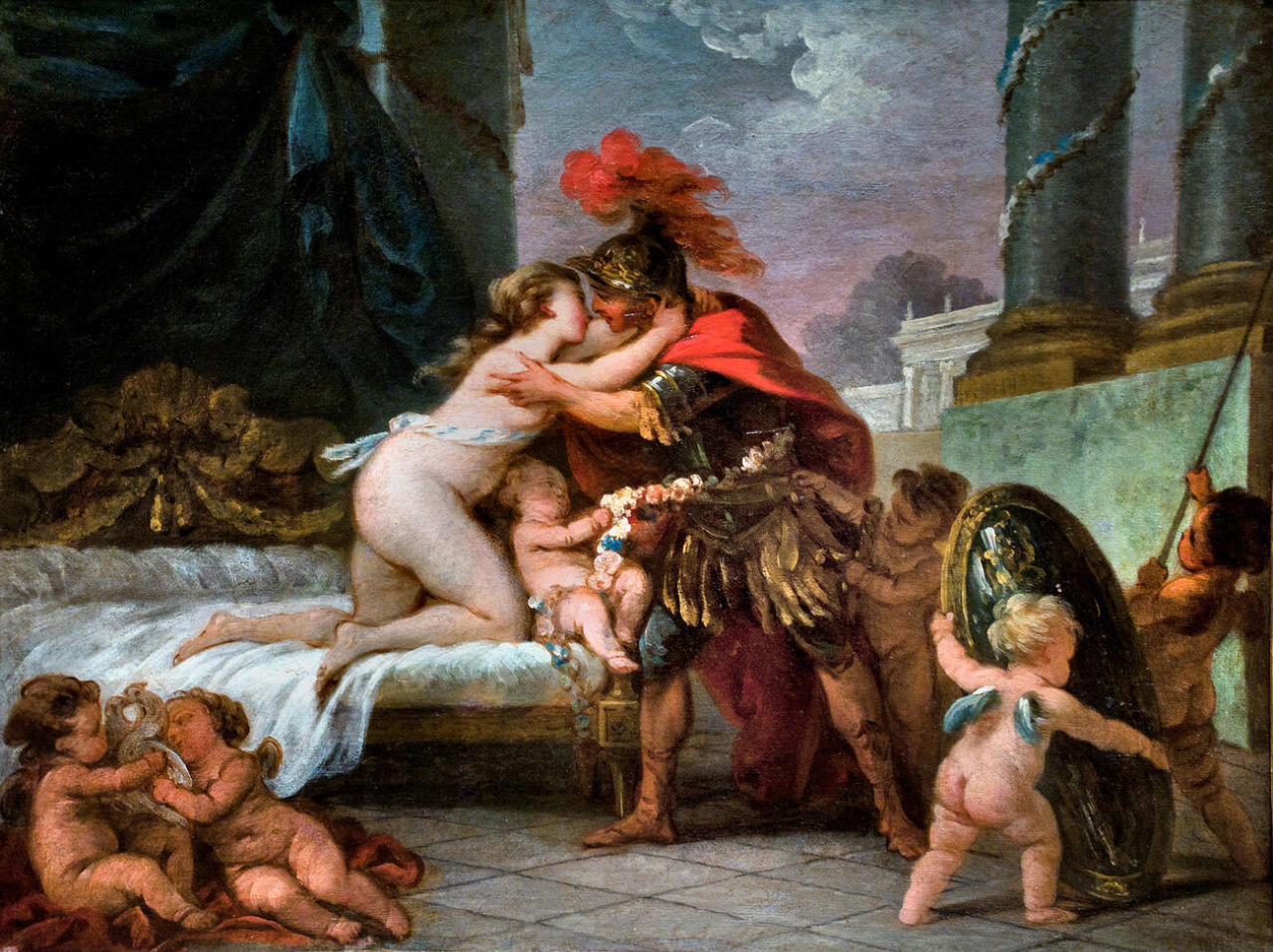
Nicolas René-Jollain: Le Retour de Mars, 1779.
When Aphrodite was born, all the gods wanted to marry her. To avoid a fight, Zeus offered Aphrodite in marriage to Hephaestus, who had a foot deformity and was therefore lame. Some sources say he was very ugly as well.
However, Aphrodite was in love with Ares who, according to some poets, was the ideal of masculinity, besides being handsome and physically perfect. But since everyone obeyed Zeus (more or less), Aphrodite married Hephaestus. He did everything to make her happy, but the goddess did not love him. So she began to cheat on her husband with Ares.
One day, Hephaestus discovered the two together and exposed them for all the gods to see. Faced with the humiliation, Ares fled to Thrace and Aphrodite to Cyprus, but some time later the two became a couple.
In various myths, it is shown that Ares does everything Aphrodite wants, even when it harms him, as for example in the Trojan War where he makes a promise to Athena that he will fight alongside the Greeks, but Aphrodite persuades him to fight alongside the Trojans, that is, causing the god to break his promise, fight against his sister Athena and lose the war.
During the Trojan War, Aphrodite is wounded in battle and asks Ares for his chariot to return to Mount Olympus, and the god agrees without hesitation. (Homer, Iliad V. 350 ff)
"Beloved brother, rescue me and give me your horses
so I may come to Olympos where is the place of the immortals.
I am in too much pain from the wound of a mortal's spear stroke,
Tydeus' son's, who would fight now even against Zeus father."
So she spoke, and Ares gave her the gold-bridled horses, and,
still grieved in the inward heart, she mounted the chariot
There is also the fit of jealousy he has towards the young and handsome Adonis, with whom Aphrodite falls in love. Ares transforms himself into a boar and kills the young man.
The two get along well together because they represent different facets of pure desire. Aphrodite represents the desire to satisfy a pleasure; and Ares represents the desire to satisfy a craving.
Passion (Aphrodite) is a feeling against which we fight (Ares) to keep ourselves sane and functional, and not to give in to a desperate craving to consume the object of our passion.
EEE
Amazons
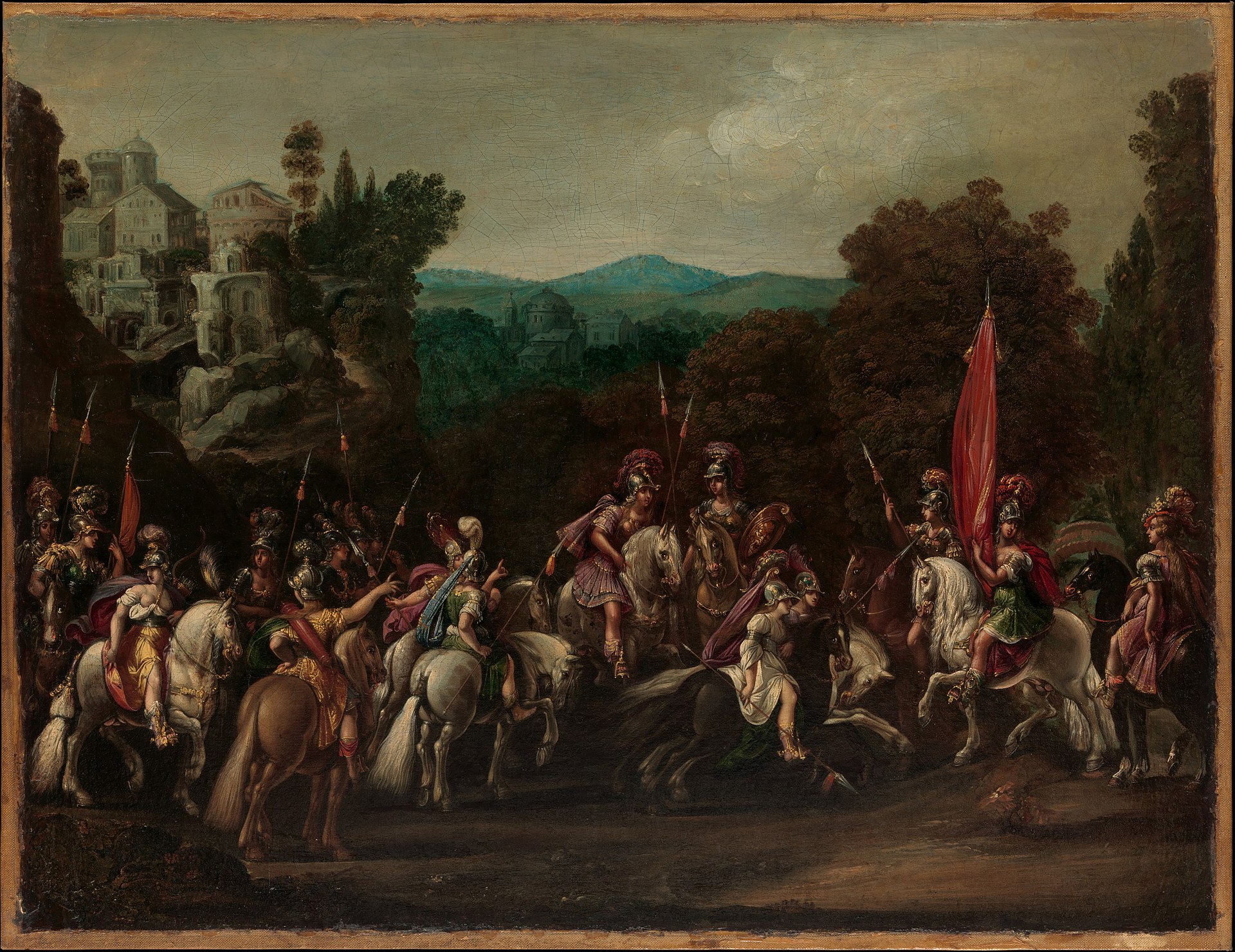
Claude Deruet: Departure of the Amazons, 1620.
Some poets say that all the Amazons were daughters of Ares and the nymph Harmonia (not to be confused with his daughter with Aphrodite, they are two different Harmonias), while others say that only the first queen of the Amazons, Otrera, was his daughter with the nymph Harmonia. Hippolyta, the Amazon queen after Otrera, and all her sisters were daughters of Ares and Otrera, making her and her sisters granddaughters of the god of war, the result of incest. Which, let's face it, is not surprising considering we are talking about Greek mythology. Zeus, for example, who was Ares' father, later becomes involved with the daughter of Harmonia and Cadmus, that is, with his great-granddaughter, and the fruit of this relationship is the god Dionysus (who would be his great-great-grandson-son and Ares' grandson-brother @_@).
Ares was very fond of the Amazons, even in the biblical sense (:'D), and favored them whenever possible. He gave Hippolyta his belt as an emblem of her reign over the Amazons (kind of like a crown).
In the Argonauts, the Amazons stopped on an island and built a temple to Ares. As a reward, he created birds that shot arrow-like feathers and attacked any men who approached.
When Penthesilea (daughter of Otrera and Ares, sister of Hippolyta) is killed by Achilles in the Trojan War, the god of war is so devastated that he flies down from Olympus like a bolt of fire and lands with such force on the battlefield that the whole Earth trembles. Ares was ready to savagely slaughter all of Achilles' soldiers, but Zeus intervened, hurling lightning bolts at the god's feet.
EEE
Ismenian Dragon
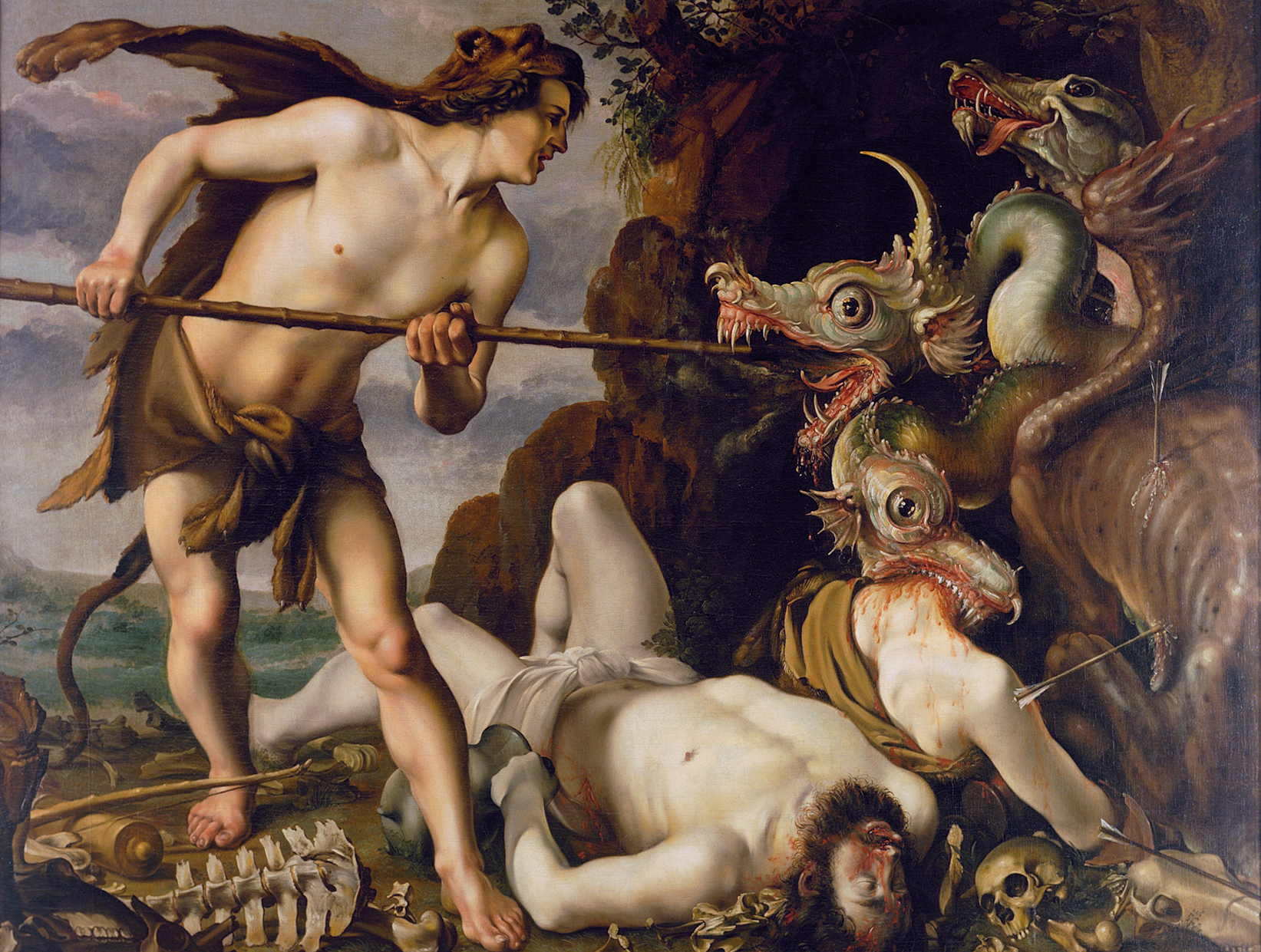
Hendrik Goltzius: Cadmus slays the dragon, 1573-1617.
Following an oracle's instructions, Cadmus was following a cow until it collapsed from exhaustion, which would mark the spot where a city should be founded. When they arrived at the location, Cadmus wanted to sacrifice the cow to the goddess Athena and ordered his men to fetch water from a nearby spring. The spring was guarded by a dragon (which was a giant serpent) and killed Cadmus's men. When he discovered what had happened, Cadmus killed the dragon.
This dragon, historically unnamed, was sometimes attributed as the son of Ares and sometimes as sacred to Ares. In any case, as punishment, Cadmus himself served Ares for 8 years.
Harmonia (daughter of Aphrodite and Ares) was given in marriage to Cadmus by Zeus to appease Ares. However, after many troubles in the city of Thebes, Cadmus and Harmonia left the city, and Ares transformed him into a snake as revenge for the slain dragon.
EEE
Orphic Hymn
Indestructible, doughty, mighty, valiant divinity,
Delighting in arms, indestructible, man-killing, stormer of cities:
Lord Ares, rattling in armor, always defiled with the slaughter of war,
Rejoicing in man-slaying blood and raising the clamor of combat, horrifying one,
You who lust for the obscene carnage of swords and spears:
Halt the raging strife! Cease the travail grieving our hearts!
Rather, yield to the peaceful yearnings of Aphrodite and the revels of Dionysus.
Exchange your fury and weapons for the gentle works of Demeter.
Conceive a desire for peacefulness which will cultivate the young and grant them blessedness.
Translation by Thomas Taylor, 1792.
EEE
Coming soon!
I plan to add more content to this shrine in the future.